

New Method for Describing Graphene Simplifies Analysis of Nanomaterials

An international team, including scientists from HSE University, has proposed a new mathematical method to analyse the structure of graphene. The scientists demonstrated that the characteristics of a graphene lattice can be represented using a three-step random walk model of a particle. This approach allows the lattice to be described more quickly and without cumbersome calculations. The study has been published in Journal of Physics A: Mathematical and Theoretical.
Graphene is one of the most recent and widely discussed materials of the 21st century. It consists of a single layer of carbon atoms arranged in a honeycomb, hexagonal lattice structure. Graphene is exceptionally strong, an excellent conductor of electricity, nearly transparent, and highly flexible. It has already been used in the production of conductive films, sensors, and miniature transistors. Similar structures occur in other carbon forms, such as fullerenes—closed spherical molecules composed of pentagons and hexagons—used in drug delivery and solar cell technology. These materials have numerous structural variants that directly influence their properties, including molecular stability. Experimentally testing each variant is costly and difficult, so scientists are seeking simpler methods to predict their characteristics.
An international team of scientists from Germany, Russia, France, and Japan, including researchers from HSE University, has proposed such a method. They simplified the description of the key parameters that determine the lattice’s behaviour into a three-step random walk model.
In this model, an imaginary particle starts at the origin of a plane and takes three equal-length steps in random directions. The target lattice parameter is then defined by the final position of the particle along the x-axis. Mathematically, this is expressed as the sum of the cosines of three random numbers corresponding to the step directions. For the calculations, it is enough to repeatedly generate random numbers, substitute them into the formulas, and add the results. Repeating this procedure many times yields values that capture the key properties of the lattice. This method describes the material without complex computations and simplifies the analysis.
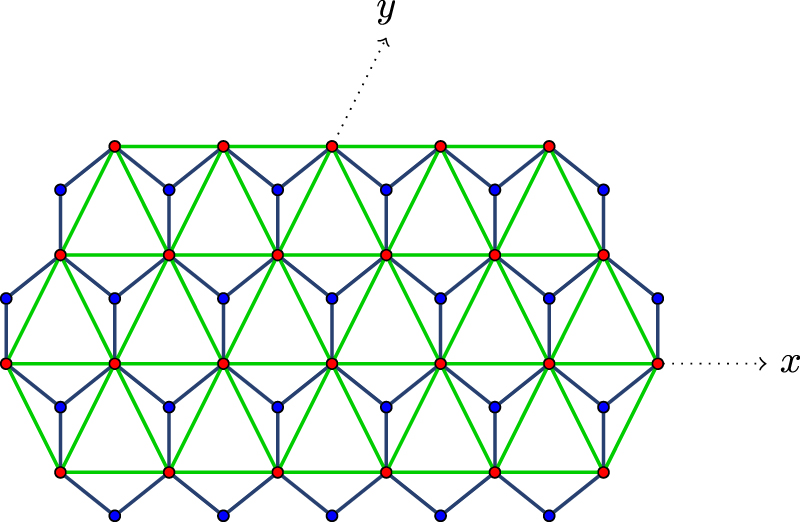
This simplified calculation method is useful not only for graphene. The authors suggest that their approach could also be applied to other carbon structures, such as fullerenes.

Victor Buchstaber
'We hypothesised that as the size of a molecule increases, random fullerenes become locally more similar in structure to an infinite graphene lattice. If this can be rigorously proven, the spectral properties of fullerenes could be derived from those of graphene, greatly simplifying their analysis,' explains Viktor Buchstaber from the International Laboratory of Algebraic Topology and Its Applications at the HSE Faculty of Computer Science.
See also:

Artificial Intelligence Transforms Employment in Russian Companies
Russian enterprises rank among the world’s top ten leaders in AI adoption. In 2023, nearly one-third of domestic companies reported using artificial intelligence. According to a new study by Larisa Smirnykh, Professor at the HSE Faculty of Economic Sciences, the impact of digitalisation on employment is uneven: while the introduction of AI in small and large enterprises led to a reduction in the number of employees, in medium-sized companies, on the contrary, it contributed to job growth. The article has been published in Voprosy Ekonomiki.
Lost Signal: How Solar Activity Silenced Earth's Radiation
Researchers from HSE University and the Space Research Institute of the Russian Academy of Sciences analysed seven years of data from the ERG (Arase) satellite and, for the first time, provided a detailed description of a new type of radio emission from near-Earth space—the hectometric continuum, first discovered in 2017. The researchers found that this radiation appears a few hours after sunset and disappears one to three hours after sunrise. It was most frequently observed during the summer months and less often in spring and autumn. However, by mid-2022, when the Sun entered a phase of increased activity, the radiation had completely vanished—though the scientists believe the signal may reappear in the future. The study has been published in the Journal of Geophysical Research: Space Physics.
Banking Crises Drive Biodiversity Loss
Economists from HSE University, MGIMO University, and Bocconi University have found that financial crises have a significant negative impact on biodiversity and the environment. This relationship appears to be bi-directional: as global biodiversity declines, the likelihood of new crises increases. The study examines the status of populations encompassing thousands of species worldwide over the past 50 years. The article has been published in Economics Letters, an international journal.
Scientists Discover That the Brain Responds to Others’ Actions as if They Were Its Own
When we watch someone move their finger, our brain doesn’t remain passive. Research conducted by scientists from HSE University and Lausanne University Hospital shows that observing movement activates the motor cortex as if we were performing the action ourselves—while simultaneously ‘silencing’ unnecessary muscles. The findings were published in Scientific Reports.
Russian Scientists Investigate Age-Related Differences in Brain Damage Volume Following Childhood Stroke
A team of Russian scientists and clinicians, including Sofya Kulikova from HSE University in Perm, compared the extent and characteristics of brain damage in children who experienced a stroke either within the first four weeks of life or before the age of two. The researchers found that the younger the child, the more extensive the brain damage—particularly in the frontal and parietal lobes, which are responsible for movement, language, and thinking. The study, published in Neuroscience and Behavioral Physiology, provides insights into how age can influence the nature and extent of brain lesions and lays the groundwork for developing personalised rehabilitation programmes for children who experience a stroke early in life.
Scientists Test Asymmetry Between Matter and Antimatter
An international team, including scientists from HSE University, has collected and analysed data from dozens of experiments on charm mixing—the process in which an unstable charm meson oscillates between its particle and antiparticle states. These oscillations were observed only four times per thousand decays, fully consistent with the predictions of the Standard Model. This indicates that no signs of new physics have yet been detected in these processes, and if unknown particles do exist, they are likely too heavy to be observed with current equipment. The paper has been published in Physical Review D.
HSE Scientists Reveal What Drives Public Trust in Science
Researchers at HSE ISSEK have analysed the level of trust in scientific knowledge in Russian society and the factors shaping attitudes and perceptions. It was found that trust in science depends more on everyday experience, social expectations, and the perceived promises of science than on objective knowledge. The article has been published in Universe of Russia.
Institute for Robotics Systems Established at HSE University
As decided by the HSE University Academic Council, a new Institute for Robotics Systems will be established at HSE, and with a strong fundamental base. It will cooperate with relevant departments across the university and engage students and doctoral candidates in research and development (R&D). First Vice Rector of HSE University and Director of the Institute for Statistical Studies and Economics of Knowledge, Leonid Gokhberg, discussed the expected practical results and the framework for cooperation with an industrial partner.
Scientists Uncover Why Consumers Are Reluctant to Pay for Sugar-Free Products
Researchers at the HSE Institute for Cognitive Neuroscience have investigated how 'sugar-free' labelling affects consumers’ willingness to pay for such products. It was found that the label has little impact on the products’ appeal due to a trade-off between sweetness and healthiness: on the one hand, the label can deter consumers by implying an inferior taste, while on the other, it signals potential health benefits. The study findings have been published in Frontiers in Nutrition.
HSE Seeks New Ideas for AI Agents: Initiative Competition Launched
HSE University is inviting researchers and lecturers to present concepts for new digital products based on artificial intelligence. The best projects will receive expert and technological support. Applications are open until December 19, 2025.